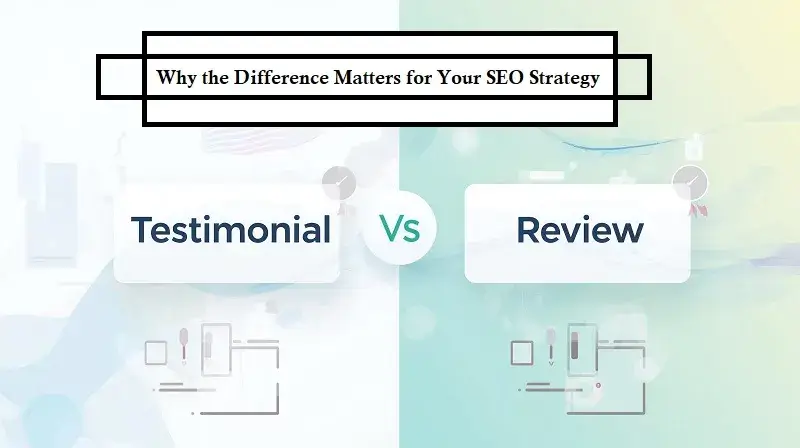
For years, Testimonial vs. Review have been treated as interchangeable.
They’re both “social proof.”
They both live somewhere on the website.
They both signal credibility.
So most brands lump them together—and move on.
That assumption quietly limits SEO performance.
Because while reviews and testimonials may look similar on the surface, they behave very differently in how they influence search visibility, user engagement, and trust signals.
And in a search landscape shaped by AI, E-E-A-T, and intent-driven discovery, understanding the difference between testimonial vs review is no longer optional—it’s strategic.
Why SEO Has Moved Beyond Keywords Alone
Modern SEO is no longer just about ranking pages.
It’s about:
- earning trust before the click,
- validating credibility after the click,
- and reinforcing confidence at the moment of conversion.
Search engines increasingly evaluate signals that suggest real-world experience, not just optimized text. That’s why user-generated content, behavioral signals, and authentic proof play a growing role in how pages perform.
Reviews and testimonials contribute to this ecosystem—but in fundamentally different ways.
What Reviews Are Designed to Do (and Where They Excel)
Reviews are reactive by nature.
They typically:
- live on third-party platforms,
- are short and standardized,
- focus on ratings rather than context,
- and reflect immediate satisfaction or dissatisfaction.
From an SEO standpoint, reviews are powerful for:
- local SEO signals,
- star ratings in SERPs,
- platform-level trust (Google Maps, marketplaces),
- and volume-based credibility.
They help search engines answer the question:
“Is this business generally trusted?”
That’s important—but incomplete.
The Structural Limitations of Reviews for SEO
Reviews struggle in areas that modern SEO increasingly values:
1. Lack of Context
Most reviews don’t explain why something worked, for whom, or under what conditions. This limits their semantic richness.
2. Platform Dependency
Reviews often live on platforms you don’t control. You benefit from them—but you don’t own the asset.
3. Thin Content Signals
Short, repetitive reviews don’t contribute meaningfully to on-page depth or topical authority.
4. Commoditization
When every competitor has a 4.6 rating, differentiation disappears.
Reviews help with validation.
They don’t help much with positioning.
What Testimonials Are Designed to Do
Testimonials are intentional.
They are:
- collected purposefully,
- embedded strategically,
- and framed around experience rather than score.
Unlike reviews, testimonials live on your owned properties—your website, landing pages, product pages, emails.
From an SEO perspective, testimonials contribute to:
- topical relevance,
- experience-based content depth,
- engagement signals (time on page, scroll),
- and conversion alignment.
They help search engines—and users—answer a different question:
“Does this solution work for people like me?”
Testimonials as Experience Signals (E-E-A-T in Practice)
Search engines increasingly emphasize Experience as part of E-E-A-T.
Testimonials are one of the few scalable ways to demonstrate experience without writing about yourself.
Why?
Because they:
- introduce first-person narratives,
- describe real-world use cases,
- reflect outcomes rather than promises,
- and add human language search engines can interpret.
A testimonial describing how a customer solved a specific problem using your product is far more valuable than a generic five-star review saying “Great service.”
Not louder—richer.
Why Testimonials Influence On-Page SEO More Than Reviews
Testimonials directly affect on-page performance metrics that SEO depends on.
When placed correctly, they:
- reduce bounce rates,
- increase dwell time,
- improve conversion completion,
- and reinforce relevance for long-tail queries.
A product page with contextual testimonials answers objections proactively. Users don’t leave to “research more”—they stay, scroll, and act.
Search engines notice that behavior.
Reviews Drive Discovery. Testimonials Drive Decisions.
This is the clearest way to frame the difference.
Reviews help users find you.
Testimonials help users choose you.
SEO today spans both phases:
- pre-click (visibility),
- post-click (confidence).
Ignoring testimonials means optimizing only half the journey.
How AI Search Has Changed the Equation
AI-powered search and recommendation systems don’t just index keywords—they synthesize consensus and credibility.
They look for:
- repeated patterns of validation,
- consistency across sources,
- and signals of lived experience.
Reviews provide volume.
Testimonials provide depth.
When both exist, trust compounds.
When only reviews exist, trust plateaus.
Video Testimonials Add a Second Layer of SEO Value
Text testimonials are powerful.
Video testimonials add another dimension.
Why?
Because video introduces:
- face,
- voice,
- emotion,
- and nuance.
From an SEO standpoint, video testimonials:
- increase time on page,
- encourage interaction,
- support multimedia search results,
- and strengthen perceived authenticity.
In a landscape flooded with AI-generated text, video acts as a credibility differentiator—both for users and algorithms.
Testimonials as Owned SEO Assets
One of the most overlooked SEO advantages of testimonials is ownership.
Unlike reviews, testimonials:
- live on your domain,
- can be structured semantically,
- can be placed near high-intent keywords,
- and can evolve with your content strategy.
They become part of your topical authority.
This is why many teams now treat testimonial collection as infrastructure rather than a one-off marketing task.
Platforms like Vidlo enable continuous collection and deployment of customer stories—making testimonials a renewable SEO asset rather than static content.
Structured Data, Rich Context, and Trust Signals
Testimonials also allow for:
- structured internal linking,
- schema alignment,
- and contextual relevance near conversion-focused content.
They can reinforce:
- product claims,
- service explanations,
- and category-level positioning.
Reviews can’t do that—they exist outside your narrative.
Testimonials integrate into it.
Common SEO Mistakes Brands Make With Social Proof
- Treating testimonials as decoration
- Isolating them on a single “Testimonials” page
- Over-polishing language and removing authenticity
- Ignoring placement near transactional intent
- Relying solely on third-party reviews for trust
Each mistake limits SEO leverage.
Testimonials work best when they are:
- specific,
- contextual,
- visible,
- and continuously refreshed.
When Reviews Matter More (And When They Don’t)
To be clear: reviews still matter.
They’re essential for:
- local SEO,
- initial credibility,
- and platform trust.
But they are not sufficient for:
- differentiation,
- experience signaling,
- or conversion-focused SEO.
Testimonials fill that gap.
SEO isn’t about choosing one or the other.
It’s about assigning each the role it’s best suited for.
The SEO Stack Needs Both — But With Different Jobs
High-performing SEO strategies use:
- reviews for reach,
- testimonials for relevance,
- and video for trust acceleration.
Together, they create a full trust arc:
visibility → validation → reassurance → action.
Ignoring testimonials leaves that arc incomplete.
Conclusion: SEO Is About Confidence, Not Just Clicks
Modern SEO doesn’t end when a user lands on your page.
It continues until they feel confident enough to act.
Reviews help users believe you exist.
Testimonials help users believe you’re right for them.
That difference matters more every year.
As search evolves toward experience-driven ranking and AI-mediated discovery, brands that recognize how important it is to establish your brand won’t just rank—they’ll convert.
And in today’s search landscape, conversion is the signal that matters most.
Related Blog Post


Popular Blog Post



Featured Products