
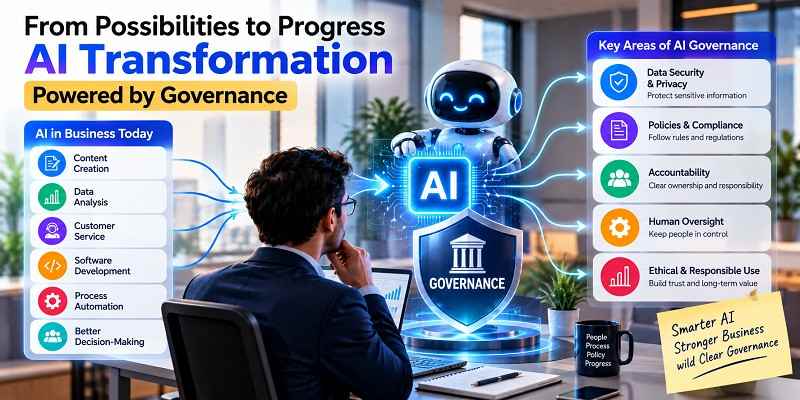
Businesses are changing how they work because of AI, but adopting AI isn’t just about picking the newest or most powerful tool. It’s becoming clear that AI Transformation is a Problem of Governance is a bigger problem as companies use AI for things like automation, data analysis, customer service, content creation, software development, and decision-making. While the technology may be able to do amazing things, businesses still need to decide how it should be used, what data it can access, who is responsible for its choices, and when human monitoring is needed.
Even a successful AI project can cause problems with security, privacy, compliance, and operations if there aren’t clear rules and clear responsibility. This piece will talk about why governance is so important to the change of AI, how businesses can handle AI properly, and how strong governance can help businesses turn AI innovations into long-term, useful business value.
What Does AI Transformation Actually Mean?
The AI transformation is typically misconstrued to mean merely adding AI to the company’s current software solutions. However, it is a much more elaborate process than that. The AI transformation occurs when an organisation begins to change the way it operates due to the implementation of AI into its workflow, product or service creation, decision-making or customer experience.
A small enterprise could start with using AI to create drafts for emails or marketing content. For a larger organisation, it could mean using AI to analyse customer behaviours, summarise internal documents, help employees, identify outliers in transactional data, forecast demand or assist software engineers. Over time, the AI solution will be able to transition from assisting with single tasks to being incorporated into crucial business processes.
This is the point where governance comes in. It will be much easier to govern an AI tool used for creating an initial draft of an internal document than an AI system that has access to customer data and is able to alter the business database.
While the technology is referred to as AI in both cases, the risks are totally different.
The AI transformation process needs to be regarded as the process of organisational change, rather than a technological one. The list of elements which are influenced by such a transformation process includes employees, customers, data, software, processes, management, security, and decisions.
Why AI Transformation Is a Governance Problem
The first mistake that companies can make is approaching AI transformation as a technology project only. Selection of a powerful AI model does not necessarily answer any questions related to the issue of accountability, privacy, security, data quality, and business decision-making. AI systems can give accurate results, but at the same time, they might fail to interpret the given instructions, provide inaccurate information, use low-quality data, or act in an unexpected way due to changes in the situation. An error that occurs when AI is applied to a straightforward internal task might be easy to fix.
However, when the same technology becomes involved in work with customer information, financial operations, recruitment processes, and other important business decisions, a mistake can have more serious implications. Governance helps companies to address such issues by establishing guidelines that state what kind of actions AI is allowed to perform, what information it can use, who can access it, when human approval is required, and how potential issues will be addressed. Moreover, NIST’s AI Risk Management Framework also sees governance as a continuous process.
AI Does Not Remove Human Responsibility
One of the most common misconceptions concerning AI is that responsibility may be delegated to the technology itself. It is impossible. Organisations retain responsibility for how AI systems are used and for the decisions and actions they are making.
When an employee uses AI to generate a report, there will always be someone who will have to verify its correctness. When an AI system suggests an action, organisations need to clarify the level of its authority. In case AI agents perform actions automatically, they need to have a responsible owner who will oversee their work and be able to react if some problems arise.
It is particularly important when AI influences clients, employees, finances, and business decisions. Organisations need to know the source of data that was used for the generation of an AI output, whether it is appropriate to use it, and at what point human intervention is needed. The AI decision should not mean anything other than an absence of responsibility. Proper AI governance retains ownership and allows human oversight and monitoring of AI activities.
The Hidden Problem Beneath AI: Legacy Systems
Sometimes the AI problem itself is not the most significant obstacle to AI implementation in enterprises. Even now, there are still many companies that rely on legacy systems developed way back before contemporary AI applications appeared. While these systems perform well for the company’s work, they often have no up-to-date APIs, real-time data access, adequate permission management, logging, and integration capabilities.
This is a serious problem when AI requires access to business data. For instance, an AI-powered assistant can require real-time inventory data, but the data might be available only through an outdated system or daily Excel file. Employees could be able to use these systems, while AI would require more efficient access.
This issue can also apply to customer management, financial services, human resources, and logistics platforms. This means that some AI transformation initiatives are actually technology modernisation efforts disguised under the name of AI development.
Governance Must Be Built Into the Architecture
The AI governance framework needs to be more than just a document or a set of guidelines. True governance needs to be embedded into the actual system and processes used by the business organisation. For instance, while the organisation may have a policy that requires the employee to only access information that he or she is authorised to access, this will become more meaningful if the identity management, permissions, access, and auditing are all embedded in the process and thus prevent any unauthorised access.
This is what needs to be done with regard to human approval. If human approval is needed before sending a message to the customer by an AI agent, then this should be technically enforced and not rely on employees to know about the policy alone.
Effective governance will involve all these different elements of architecture, identity management, data protection, access, monitoring, logging, and workflow.
Data Governance Becomes More Important With AI
The success of any AI transformation is highly dependent on the availability of data. This implies that data governance is a crucial element of the process of implementing any successful AI project. For an AI solution to produce accurate outcomes, it is important for it to have access to accurate, complete, updated, and trusted data. Data which is outdated, duplicated, incomplete or wrongly sourced can produce inaccurate yet very convincing results.
Companies keep data related to customers, operations and finances in multiple systems, and the same information can be identified differently in various systems. While experienced employees may understand the information, AI cannot easily identify connections or discrepancies without guidance.
This is why companies require clearly defined data ownership, data quality standards and data lineage. Companies must be aware of the source of the data, the owner of the data, the frequency of updates, and whether it can be accessed by an AI system.
The Rise of Shadow AI
The explosive proliferation of AI capabilities has introduced an entirely new challenge for companies Shadow AI. It means that employees can employ advanced AI services without having prior approval from their employer. They may use AI to summarise documents, perform analysis of spreadsheets, rewrite emails, generate pictures or investigate business-related issues. Such an initiative, on the one hand, can increase efficiency; however, at the same time, there might be considerable governance and security concerns raised.
It is unclear what kind of AI services are used by the employees, what business-related information is shared by them, how data processing is done, and whether those services are meeting all the company’s security standards. Banning all external AI solutions will probably not help to tackle the issue, as people will keep using them in private.
The best way forward would be to provide approved AI tools together with detailed usage policies, relevant training for employees, and proper security measures.
AI Agents Increase the Governance Challenge
As the role of artificial intelligence changes from responding to a question to carrying out actions and making decisions, governance becomes a critical issue. The typical chatbot gives information to the user, who makes the decision based on the information. AI agents, on the other hand, have the capability to carry out several actions independently using the tools and permissions that they are provided. They can access files and other information, browse websites, use APIs, create content, update systems or initiate business processes.
The organisation needs to set the guidelines for which actions can be carried out by the AI agent automatically, which actions need human approval, and which ones cannot be taken under any circumstances. An example is that an AI agent can make a purchase order but cannot approve it, can access customer information but not change the financial information, and can write an email but cannot send it without the approval of employees.
The Future of AI Transformation
The evolution of AI-driven transformation will not be limited to technologies that produce text, images, and information. AI-based agents can become capable of planning tasks, working with digital tools, acquiring information, interacting with software, analysing data, and performing complicated workflows with reduced human involvement. Such developments may bring fundamental changes to how companies operate and manage business processes since, instead of controlling every aspect themselves, people will have to specify objectives and let AI drive other aspects of the workflow.
At the same time, enhanced AI means an increased number of governance issues. With growing access granted by businesses to their data, applications, and workflows, there will need to be clear guidelines regarding the permission levels and responsibilities.
Conclusion
AI Transformation is a Problem of Governance because artificial intelligence does not work independently of the enterprise adopting it. As AI becomes tied to company data, workers, consumers, apps, and crucial decisions, technology alone is not enough to assure effective and ethical adoption. A corporation may utilise a sophisticated AI model and yet suffer challenges when its data is inconsistent, systems are unconnected, permissions are unclear, or accountability is lacking. This is why governance should be incorporated from the outset of any AI transformation effort.
Effective AI governance brings together data management, security, architecture, ownership, human supervision, monitoring, and accountability. These sectors must work together to mitigate risks while enabling innovation and corporate success. The strongest AI approach is not about deploying the most tools. It is about finding where AI can generate actual benefit and placing the necessary controls around it.
As AI grows more powerful and independent, governance will become a vital feature of contemporary company processes. AI offers intelligence, whereas governance provides the direction, limits, and responsibility required for lasting change.